




















Baby’s First Bath: When, How Often, and How Safe?
Direct answer: There is no mandatory date for your baby's first bath. If your baby is healthy and stable, you can bathe them as soon as you both feel comfortable with it. According to the German Federal Institute for Public Health, an unremarkable umbilical cord stump can briefly get wet; washing with a soft wash mitt is also completely sufficient until it has fully healed. Plan for body-warm water at 36 to 37 °C, five to ten quiet minutes, and have everything within easy reach beforehand. The most important thing is: Your baby must remain safely in your hand throughout the entire bath and never be left unattended.
For many parents, the first bath at home feels like a bigger deal than it actually needs to be. The tub is ready, the towel is lying next to it – and yet questions arise: Has the umbilical cord stump healed enough yet? How do I hold my baby? Do I need bath additives? And what if they cry?
The good news: A newborn does not need to be bathed every day and does not need a long care routine. A short, well-prepared process is usually more pleasant than a perfect ritual. This guide will lead you step by step through your baby's first bath and separate necessary safety rules from things that may simply be practical.
Your baby's first bath at a glance
| Question | Practical guidance |
|---|---|
| When? | When your baby is healthy and stable and you feel confident. If in doubt about the umbilical cord stump, ask your midwife or pediatrician's office. |
| How often? | Once or twice a week is usually sufficient. |
| How long? | Five to ten minutes; for more frequent baths, no more than about five minutes. |
| Water temperature? | Body-warm, about 36 to 37 °C, checked with a bath thermometer. |
| What in the water? | Clear water is usually sufficient; bubble bath is not necessary. |
| Most important rule? | Always keep one hand on your baby and never leave them alone, even for a moment. |
When can a newborn be bathed?
There is no rigid age recommendation. The German Federal Institute for Public Health explains that a baby can be bathed even before the umbilical cord stump has completely healed, provided it looks normal. The stump should be gently patted dry afterward. At the same time, bathing is not necessary during this phase: a damp wash mitt is sufficient.
Other specialist recommendations advise a more cautious approach, waiting until the umbilical cord stump has healed before the first full bath. These different recommendations are no cause for concern. In everyday practice, this means: If the stump is dry and looks normal, there is no general bathing ban according to current BIÖG information. If you feel unsure, wait a little longer and have your midwife or pediatrician's office take a quick look at it.
What do you need for your baby's first bath?
You usually do not need more than a secure tub or suitable bath insert, a thermometer, a soft cloth, and a dry towel. What matters less than the amount of equipment is its placement: Everything must be within reach without you having to turn away from your baby or leave the room.
- Baby tub or secure bathing area on a stable surface
- Bath thermometer
- soft wash mitt or washcloth
- large, dry towel right next to you
- fresh diaper and clean clothes at the prepared changing area
- optionally a second adult the first time
Also prepare the process after the bath. A securely set up changing area without a changing table works just as well, as long as everything is stable, warm, and within reach.
Bathing your baby for the first time: Step by step
1. Choose the right time
Choose a time when your baby is awake, calm, and not hungry. Bathing right after a meal is also not ideal. It does not have to be an evening ritual: Some babies are more relaxed in the morning, others in the early evening.
2. Prepare the room and water
The BIÖG recommends a room temperature of at least 23 °C. Fill the tub completely before putting your baby in it. Check with the bath thermometer for 36 to 37 °C. While your baby is in the water, no hot water should be running.
3. Hold your baby safely
Slide your forearm under their neck and head. With the same hand, hold your baby's upper arm at shoulder height. This keeps their head safely above water while leaving your other hand free for washing. If this grip is still unfamiliar to you, have it shown to you during a postpartum visit; our article on the tasks of the midwife during the postpartum period explains how she can support you.
4. Wash gently and briefly
Wash your baby by hand or with a soft cloth, starting from their face and moving toward their feet. Pay special attention to skin folds on the neck, armpits, and groin. Wash their hair last so that their head does not cool down unnecessarily. Clear water is usually sufficient.
5. Wrap them up immediately and pat dry
After five to ten minutes, lift your baby out safely and immediately wrap them in the prepared towel. Pat the skin dry instead of rubbing. Dry skin folds and, if applicable, the umbilical cord stump particularly carefully.
How often should a baby be bathed?
Once or twice a week is completely sufficient for most babies. Daily bathing tends to stress sensitive skin rather than care for it. On the other days, it is enough to clean the face, neck folds, hands, and diaper area as needed with a damp cloth.
The official recommendation is also: five to ten minutes per bath. If bathing more frequently, it should remain even shorter. If your baby has very dry, inflamed, or unusual skin, please discuss suitable care with your midwife or pediatrician's office instead of trying out many products on your own.
What belongs in the bathwater?
Usually just water. Bubble bath, fragrances, and regular soap are not necessary for your baby's first bath. If a wash lotion is used later, the BIÖG recommends a skin-friendly pH of 5.5 to 6. For very dry skin, a moisturizing bath additive may be useful after consulting a professional.
"More care" is not automatically better. A short list of ingredients and sparing use are often the more sensible choice for sensitive baby skin.
Practical textiles for the first bath
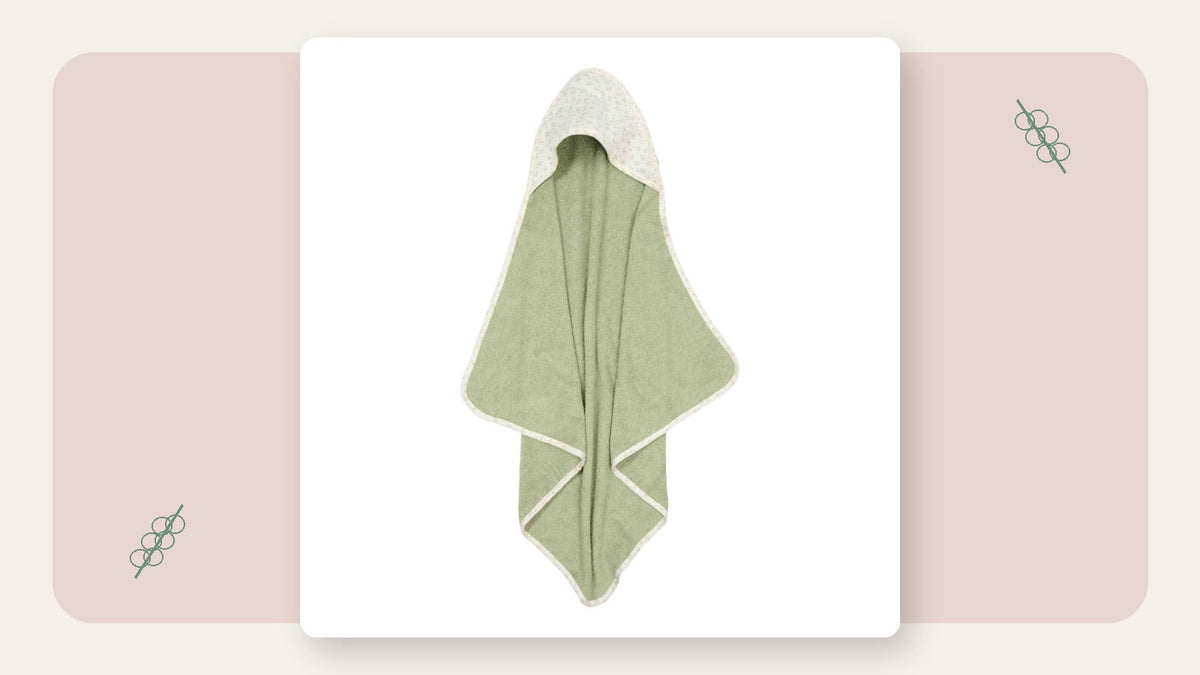
The following products are not a medical necessity. However, they can make the process easier because the wash mitt and towel are quickly within reach. All linked products were active and available in at least one version during the review.


Which towel size suits your everyday life is shown in the separate comparison of 75 × 75 or 100 × 100 cm. There it is specifically about the purchasing decision; here the safe bathing process remains the main topic.
View bath towels & hooded towels
Typical mistakes during your baby's first bath
- Forgetting something and briefly walking away: Always take your baby with you, even if only a diaper or towel is missing.
- Checking the temperature only with your hand: A bath thermometer makes the check more reliable.
- Letting hot water run: This creates dangerous temperature zones and scalding risks.
- Bathing for too long: Five to ten minutes are enough.
- Too many care products: Clear water is usually the best base to start with.
- Sticking to the ritual even though the baby is stressed: End the bath calmly and try again another day.
If your baby cries during the bath
Crying does not automatically mean that your baby generally does not like water. Perhaps they are hungry, tired, cold, or startled when put down. Keep the first bath short, speak calmly, and try a different time of day. Some families start with the wash mitt and only approach the tub later.
Even a "canceled" first bath is not a failure. Safety and a calm conclusion are more important than a complete process. For further preparation for the first days, you will find a separate checklist in our guide to the first night with baby at home.
Conclusion
Your baby's first bath needs neither a perfect time nor extensive equipment. A healthy, stable infant can be bathed as soon as you feel confident; with an unremarkable umbilical cord stump, short bathing is possible according to the BIÖG, but washing with the cloth is also sufficient. Body-warm water, a warm room, five to ten minutes, and continuous supervision are the most important cornerstones.
Frequently asked questions about your baby's first bath
Must the umbilical cord stump have fallen off before the first bath?
Not necessarily. The BIÖG allows short bathing if there are no signs of inflammation, but recommends carefully patting dry afterward. Since other specialist sources advise waiting until it has healed, it is sensible to consult your midwife or pediatrician's office if in doubt.
How warm should the bathwater be?
About 36 to 37 °C. Check the temperature with a bath thermometer before your baby gets into the water.
How long can a newborn bathe?
Five to ten minutes are enough. If bathing more frequently, it should last no more than about five minutes.
Does my baby need bath additives?
Usually not. Clear water is sufficient for the first bath. For skin problems or very dry skin, suitable care should be individually coordinated with a professional.
Can I bathe my baby in the sink?
Only if the space is hygienic, stable, large enough, and safely temperable. Faucets and hard edges increase the risk of injury and scalding. A baby tub on a solid surface is often easier to control.
What do I do if my baby gets cold?
End the bath, wrap your baby immediately in a dry towel, and warm them in a pleasantly tempered room. For the next attempt, you can prepare the room, towel, and clothes even more thoroughly.
Can a bath aid replace supervision?
No. Bath seats and other aids replace neither the secure grip nor the uninterrupted supervision by an adult.
- German Federal Institute for Public Health: Bathing the baby, as of May 28, 2026.
- German Federal Institute for Public Health: Umbilical cord care for babies, as of June 1, 2026.
- German Pediatric Association: Frequency and safety when bathing, updated September 17, 2026.
