

Which Pikler triangle is right for us? Buying guide for families
The right learning tower depends first on your space and the number of children: For one child and a smaller kitchen, a classic model with a width of around 40 cm is usually the practical choice. If two children are to help out at the same time, a wide sibling learning tower offers more standing area. Color and personalization mainly change the appearance; for everyday practicality, dimensions, adjustable footrests and standing surfaces, a fixed location, and constant adult supervision are more important.
Which learning tower suits which family routine?
| Situation | Sensible choice | What to look out for |
|---|---|---|
| One child, narrow kitchen | Classic learning tower | Measure the standing area and walkways beforehand |
| Siblings or twins | Wide sibling model | Enough free workspace and clear rules for both |
| Use for several years | Grow-with-me model | Regularly adjust the standing and footboard to the right height |
| Birthday gift | Optionally personalizable version | Coordinate dimensions, color, and desired spelling beforehand |
The five most important selection criteria
1. Assess the standing area, not the product photo
In everyday life, a learning tower doesn't just stand decoratively against the wall. It is pushed up to the countertop or sink, the child gets in and out, and adults must still be able to pass safely behind it. Therefore, measure the intended spot including the walkway. According to the product specifications, the classic tiSsi Felix is approximately 40 × 91 × 45 cm; the sibling model is approximately 55 cm wider, while the height and depth remain comparable.
2. One child or two children at the same time?
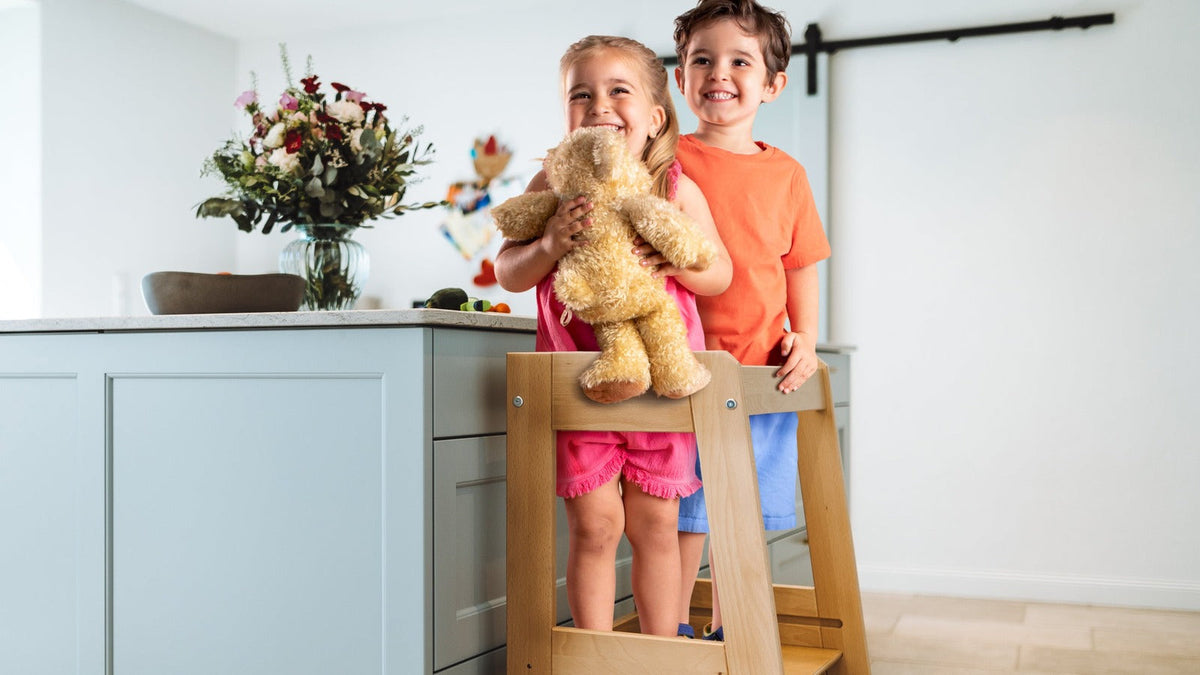
For a single child, a particularly wide tower usually offers no additional benefit but takes up more space. A sibling learning tower is worth it if two children really want to help or watch regularly at the same time. It still does not replace supervision: Two children influence each other, change positions, or reach for objects at the same time. Therefore, plan not only more standing area, but also a wider safe work zone.
3. Grow-with-me means: readjust regularly
Adjustable standing and footboards are helpful because the tower can be adapted to the child's height. But grow-with-me does not mean "assemble once and forget." Check periodically whether the child can get in comfortably, stand safely, and reach the work surface without stretching or climbing. The product description for the sibling model lists three positions for the standing and footboard; the classic Felix variants are also adjustable in three stages.
4. Weigh the surface and color honestly
Natural, oak look, white, or yellow differ mainly in how the learning tower fits into your kitchen. Those who accept visible everyday traces are often unconcerned with natural wood. Light or colored variants set a conscious accent. However, color should never be a more important purchasing argument than suitable dimensions, a stable stand, and correct assembly.
5. Personalization and accessories only if they offer real benefits
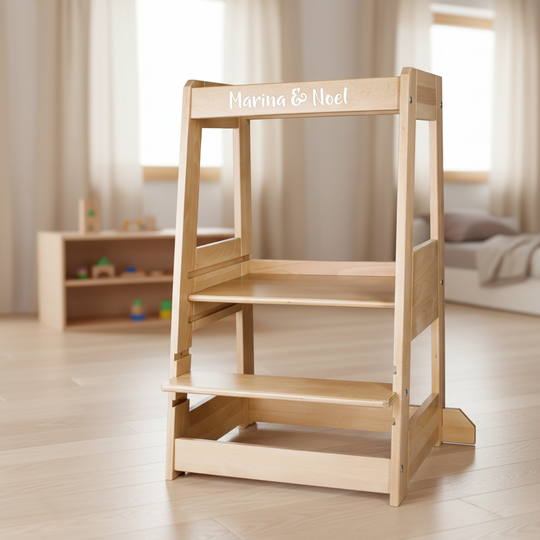
A name makes the learning tower a personal family piece or gift. Check the spelling before ordering and note that personalization is delivered separately with some variants. Accessories are also not mandatory: Non-slip mats can provide additional grip on the intended surfaces, and a hangable box keeps light utensils close at hand. Both are only useful if they suit your actual use and leave the movement area free.
From what age is a learning tower useful?
The manufacturer describes the Felix for children from approximately one to six years. However, a year alone is not enough to make the decision. It is only useful when the child can stand stably, master the steps in a controlled manner, and follow simple everyday rules. Development is individual; in case of doubt, observed ability counts more than the birthday.
The Federal Institute for Public Health points out that the risk of accidents is particularly high in the second year of life because children greatly expand their range of motion but cannot yet reliably assess dangers. In the kitchen, risks of falling, burns, and scalding come together. A learning tower creates increased participation, but does not make hot pots, knives, or electrical devices safe.
Concrete selection: seven suitable products
The following products were active during the review, publicly accessible, and available in at least one variant. The cards also deliberately show accessories: This way you can distinguish between "selecting a tower" and "sensibly complementing an existing tower."


Which model would we choose for which need?
For the small family kitchen: a classic Felix in the surface that matches your furniture. The function remains comparable; natural, white, yellow, or oak are not different developmental stages.
For twins or two siblings of similar age: the wide sibling model, provided that 55 cm width plus a safe walkway really exist. Don't buy it just "as a backup" if the second child will not use the tower together for a long time.
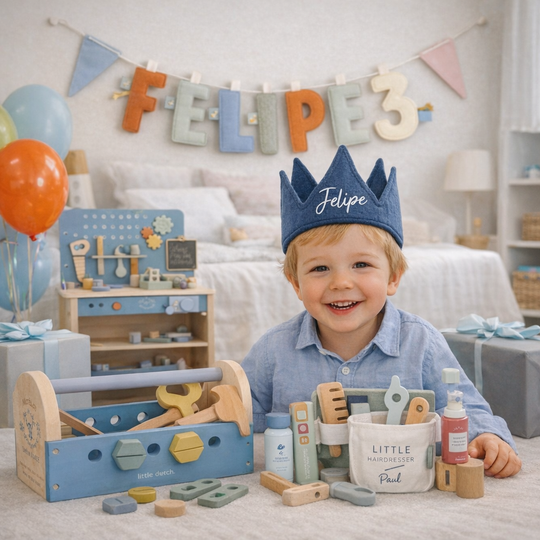
As a personal gift: a personalizable variant – but only after consulting with the parents about the color, location, and spelling. A learning tower is a piece of furniture; surprises in dimensions or color are unnecessary.
For an already existing Felix: specifically complement accessories when a concrete need has arisen. An accessory package without an everyday test often only leads to parts that later remain unused.
Avoid typical wrong purchases
- Only buy by age: Safe standing, controlled climbing, and following simple rules are more important than a number on the packaging.
- Forget the depth: Not only the width, but also about 45 cm depth plus entry and walkway should be planned.
- Choose a sibling model without a work surface: Two children need not only space in the tower, but also a safe task next to each other.
- Treat personalization as a functional feature: A name is emotionally beautiful, but does not make the tower more suitable or safer.
- Choose the location at the stove: The higher position must not make hot surfaces, pots, cables, or knives accessible.
- Do not check the adjustment and screws: After assembly and adjustment, check all intended connections according to the manufacturer's instructions.
If your focus is not on helping out in the kitchen or bathroom, but on free balancing and age-appropriate movement, our guide "Motor skill toys by age" will help you additionally. For the concrete choice between a wobble board and modular elements, there is also the Balance Board Comparison.
Conclusion: First clarify everyday life, then choose the color
The best learning tower is not automatically the largest or most striking. For most families with one child, a classic, grow-with-me model is the space-saving decision. A sibling learning tower is worth it if two children use it regularly at the same time and the kitchen offers enough space. Measure the location, assess the child's abilities, plan a safe work zone, and only then decide on the surface, personalization, and accessories.
Frequently asked questions about buying a learning tower
Which learning tower fits in a small kitchen?
For little space, a classic single model is usually more sensible than a sibling tower. Measure not only the product width, but also the depth, entry, and the remaining walkway.
Do two children absolutely need a sibling learning tower?
No. It is worth it mainly if both help out frequently at the same time. With a large age difference or rare parallel use, a single model can be sufficient organizationally and spatially.
Is a learning tower automatically suitable from one year?
No. The manufacturer's specification is only a framework. The child should stand stably, get in and out in a controlled manner, and understand simple rules; use continues under direct supervision.
Is natural wood more practical than lacquered colors?
The choice is predominantly visual. The deciding factors are workmanship, care instructions, and handling in everyday life. Regularly check the condition of every surface and stick to the manufacturer's care.
Is personalization worth it?
As a family piece or gift, a name can seem very personal. Functionally, personalization is not necessary; spelling and delivery method should be checked before ordering.
Which accessories are sensible first?
Accessories should solve an observed need. For some families, suitable non-slip mats are helpful; others benefit more from a small box. Do not automatically buy everything together.
Where should a learning tower stand in the kitchen?
At a stable, harmless work zone on level, dry ground – away from the stove, hot liquids, knives, cables, and open windows. Adults stay immediately with them.
